Showing posts with label Mendeley. Show all posts

These are my species - finding the taxonomic names I published using Mendeley

The latest addition to my mapping of taxonomic names to the literature (http://iphylo.org/~rpage/itaxon/) is the ability for authors with Mendeley accounts to find the names they've published. This is an extension of the "I wrote that" tool I developed earlier.

Let's say I want to show the names that a given author has published. I could search by that author's name, but that raises all sorts of issues (see my earlier posts ReaderMeter: what's in a name? and Equivalent author names), especially for this database where I have incomplete citations and in many cases lack author names beyond surname.

Another way to tackle the problem is if I have a list of publications for an author, then all I need to do is match that list to the publications in my taxonomic database. If both lists have identifiers for the publications, such as DOIs, then the task is trivial. But, where do I get these lists?

An obvious source is Mendeley, where people are building lists of their own publications (as well as other publications that they are interested in). For example, my publications are listed at http://www.mendeley.com/profiles/roderic-page/.

But I don't want to have to get these lists myself, I'd much rather that a Mendeley user could go to my taxonomic database, say "I have this Mendeley account, show me the names I've published". One reason I'd like to do this is that if I want people to engage with this project it would be nice to be able to offer an immediate reward, in this case, a place where you can show your contribution to the task of cataloguing life on this planet.

Finding my taxonomic names

If you have a Mendeley account here's what you do:

Go to http://iphylo.org/~rpage/itaxon/. At the top right you will see a "Sign in using Mendeley" link.
M1
Click this and you will be taken to Mendeley where you will be asked if you'd like to allow http://iphylo.org/~rpage/itaxon/ to connect to your account (if you're already logged in to Mendeley then you'll see an Accept button, otherwise Mendeley will ask you to log in).

M2
If you click on Accept then you will be taken back to my site and you should now see your profile name and picture on the top right:

M3

If you click on the Profile link then my site will talk to Mendeley and get a list of your papers and look for them in my database. If it find a paper it outputs the taxonomic names published in that paper. For example, here is my profile:

M4

Listed are the species of bird lice in the genus Dennyus described in a paper on which I was a coauthor (http://dx.doi.org/10.1046/j.1365-3113.1996.d01-13.x).

This list is incomplete as earlier papers of mine on crab and isopod taxonomy aren't listed because these lack identifiers. This is something I need to work on, but for now this seems like a simple way to enable someone to go to the http://iphylo.org/~rpage/itaxon/ mapping between taxonomic names and literature and find the names they've authored.

If you have a Mendeley account, and your list of publications in Mendeley includes papers describing new animal species, go to http://iphylo.org/~rpage/itaxon/ and try it out.

Phantom articles: why Mendeley needs to make duplication transparent

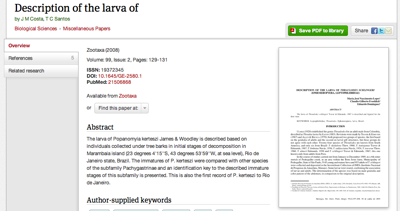
Browsing Mendeley I found the following record: http://www.mendeley.com/research/description-larva/. This URL is for a paper
Costa, J. M., & Santos, T. C. (2008). Description of the larva of. Zootaxa, 99(2), 129-131
which apparently has the DOI doi:10.1645/GE-2580.1. This is strange because Zootaxa doesn't have DOIs. The DOI given resolves to a paper in the Journal of Parasitology:
Harriman, V. B., Galloway, T. D., Alisauskas, R. T., & Wobeser, G. A. (2011). Description of the larva of Ceratophyllus vagabundus vagabundus (Siphonaptera: Ceratophyllidae) from nests of Rossʼs and lesser snow geese in Nunavut, Canada. The Journal of parasitology, 93(2), 197-200
Now, this paper has it's own record in Mendeley.

OK, so this is weird..., but it gets weirder. If you look at the Mendeley page for this chimeric article there is a PDF preview of yet another article:
LOPES, Maria José Nascimento; FROEHLICH, Claudio Gilberto and DOMINGUEZ, Eduardo (2003). Description of the larva of Thraulodes schlingeri (Ephemeroptera, Leptophlebiidae). Iheringia, Sér. Zool. 92(2), 197-200 2003 doi:10.1590/S0073-47212003000200011
Mendeley duplicate

But it gets even more interesting. The abstract for the phantom Zootaxa article belongs to yet another paper:
Marques, K. I. D. S., & Xerez, R. D.Description of the larva of Popanomyia kerteszi James & Woodley (Diptera: Stratiomyidae) and identification key to immature stages of Pachygastrinae. Neotropical Entomology, 38(5), 643-648.
which also exists in Mendeley.

To investigate further I used Mendeley's API to retrieve this record (I had to look at the source of the web page to find the internal identifier used by Mendeley, namely 010c48d0-edb5-11df-99a6-0024e8453de6 to do this, why does Mendeley hide these?). Here's the abbreviated JSON for this record.

{
...
"website": "http:\/\/www.ncbi.nlm.nih.gov\/pubmed\/21506868",
"identifiers": {
"pmid": "21506868",
"issn": "19372345",
"doi": "10.1645\/GE-2580.1"
},
...
"issue": "2",
"pages": "129-131",
"public_file_hash": "fe7eed3f6c43a3be1480a0937229b9ad33666df4",
"publication_outlet": "Zootaxa",
"type": "Journal Article",
"mendeley_url": "http:\/\/www.mendeley.com\/research\/description-larva\/",
"uuid": "010c48d0-edb5-11df-99a6-0024e8453de6",
"authors": [
{
"forename": "J M",
"surname": "Costa"
},
{
"forename": "T C",
"surname": "Santos"
}
],
"title": "Description of the larva of",
"volume": "99",
"year": 2008,
"categories": [
39,
203,
37,
52,
43,
40,
210
],
"oa_journal": false
}

Doesn't add much to the story, but does give us the sha1 for the PDF for the chimeric article (fe7eed3f6c43a3be1480a0937229b9ad33666df4). If I download the PDF for the article in Iheringia, Sér. Zool. it has the same sha1:


openssl sha1 a11v93n2.pdf
SHA1(a11v93n2.pdf)= fe7eed3f6c43a3be1480a0937229b9ad33666df4

This article doesn't exist
So, to summarise, this paper doesn't exist. It is credited to a journal that doesn't have DOIs, the DOI resolves to an article in a different journal, the abstract comes from another article in another journal, and the PDF is from a third article. OMG!

This is just weird
So, something about the way Mendeley merges references is broken. Merging references is a tough problem so there will always be cases where things go wrong. But it would be really, really helpful if Mendeley could display the set of articles that it has merged to create each canonical reference (say by listing the UUIDs for each article). Users could then see if badness had happened, and provide feedback, for example by highlighting references that are clearly the same, and those that are clearly different. Until this happens I'm a bit nervous about trusting Mendeley with my bibliographic data, I don't want it mangled into chimeric papers that don't exist.

Suggested apps for BHL's Life and Literature Code Challenge


Since I won't be able to be at the Biodiversity Heritage Library's Life and Literature meeting I thought I'd share some ideas for their Life and Literature Code Challenge. The deadline is pretty close (October 17) so having ideas now isn't terribly helpful I admit. That aside, here are some thoughts inspired by the challenge. In part this post has been inspired by the Results of the PLoS and Mendeley "Call for Apps", where PLoS and Mendeley asked for people (not necessarily developers) to suggest the kind of apps they'd like to see. As an aside, one thing conspicuous by it's absence is a prize for winning the challenge. PLoS and Mendeley have a "API Binary Battle" with a prize of $US 10,001, which seems more likely to inspire people to take part.

Visual search engine
I suspect that many BHL users are looking for illustrations (exemplified by the images being gathered in BHL's Flickr group). One way to search for images would be to search within the OCR text for figure and plate captions, such as "Fig. 1". Indexing these captions by taxonomic name would provide a simple image search tool. For modern publications most figures are on the same page as the caption, but for older publications with illustrations as plates, the caption and corresponding image may be separated (e.g., on facing pages), so the search results might need to show pages around the page containing the caption. As an aside, it's a pity the Flickr images only link to the BHL item and not the BHL page. If they did the later, and the images were tagged with what they depict, you could great a visual search engine using the Flickr API (of course, this might be just the way to implement the visual search engine — harvest images, tags with PageID and taxon names, upload to Flickr).

Mobile interface
The BHL web site doesn't look great on an iPhone. It makes no concessions to the mobile device, and there are some weird things such as the way the list of pages is rendered. A number of mainstream science publishers are exploring mobile versions of their web sites, for example Taylor and Francis have a jQuery Mobile powered interface for mobile users. I've explored iPad interfaces to scientific articles in previous posts. BHL content posses some challenges, but is fundamentally the same as viewing PDFs — you have fixed pages that you may want to zoom.

OCR correction
There is a lot of scope for cleaning up the OCR text in BHL. Part of the trick would be to have a simple use interface for people to contribute to this task. In an earlier post I discussed a Firefox hOCR add-on that provides a nice way to do this. Take this as a starting point, add a way to save the cleaned up text, and you'd be well on the way to making a useful tool.

Taxon name timeline
Despite the shiny new interface, the Encyclopedia of Life still displays BHL literature in the same clunky way I described in an earlier blog post. It would great to have a timeline of the usage of a name, especially if you could compare the usage of different names (such as synonyms). In many ways this is the BHL equivalent Google Books Ngram viewer.

These are just a few hastily put together thoughts. If you have any other ideas or suggestions, feel free to add them as comments below.

- Posted using BlogPress from my iPad

Mendeley Hack4Knowledge: towards an "ego wall"

I'm taking a virtual part in Mendeley's Hack4Knowledge event. I'm using this a chance to explore some ideas about building novel interfaces to bibliographic data in Mendeley. One idea is to display a user's entire library in one screen. I think the user interfaces employed by most bibliographic software are too conservative and there some cool things that could be done. For example, see A fluid treemap interface for personal digital libraries (doi:10.1145/1065385.1065512, PDF available from CiteSeer).

One idea I'm playing with is to display all a Mendeley user's papers as a quantum treemap, with thumbnails of the papers and "badges" indicating, for example, how many readers each paper has. The idea is that at a glance you can see all your publications, and which ones are being read the most. You can think of it as an "ego wall" — a quick way to see what others think about your work. Below is part of my library. You can see the full treemap here as an SVG file. Imagine this as an iPad interface to a user's Mendeley library.

Wall

Eventually I'll make this live. I'm doing this yet as the script to create the visualisation is slow due to the multiple requests I need to make to get the necessary information. I have to get the list of a user's papers from Mendeley, then I call the API for each paper to get basic bibliographic details. I have to screen scrape the corresponding paper's web page to get the thumbnail and the paper's UUID, which I can then use to get the readership stats via Mendeley's API via yet another API call. Sigh.

Anyway, this is enough hacking for one day. Hope to spend some more time on this project tomorrow.


I wrote that: asserting authorship using the Mendeley API

Inspired by the forthcoming Hack4Knowledge I've put together a service that enables you to assert that you are the author of a paper using the Mendeley API.

If you are impatient, give it a try at:

http://iphylo.org/~rpage/hack4knowledge/iwrotethat/

To use it you need a Mendeley account. When you go to I wrote that you will be asked to connect to your Mendeley account. Once you've done that, enter the DOI or PubMed ID of a paper and, if the paper is in your Mendeley library and flagged as a paper you've authored, you should see something like this:

Wrote

The site can be a little sluggish as it needs to go through all of your publications one by one until it finds a match.

Why?
Imagine you have a web database that includes publications, and you want people to join your site as users. If they have publications in your database, you'd like your users to be able to say "I'm the author of those papers" or, more generally, the author you have as "Roderic D. M. Page" is me.

One way to do this would be to enable the users to sign in to your site using Mendeley (see my blog post Mendeley connect). Once they've done that, the user could select a publication and say "that's mine". How do we test this assertion? Well, if the user is indeed the author it is likely that they will have added it to their "My Publications" section in their Mendeley library. So, we can use the Mendeley API to get a list of the author's publications and see whether the publication they claim is, in fact, one of theirs.

The inspiration for this came from tools like Google Analytics, where in order to add the tool to your web site you need to convince Google that you own the site. One way to do this is to add some text supplied by Google to the HTML on for site, on the assumption that only you can do this (because it's your site). In the same way, only you can add papers to your Mendeley library. Of course, I'm assuming that Mendeley users are being trustworthy when they and papers to "My Publications" (i.e., they're not claiming authorship on papers they didn't write).

How?
This hack uses Mendeley's OAuth support (the same technology used by Twitter and Facebook to connect to other sites) to enable you to connect your Mendeley account to the "I wrote that" application (note that my app never sees your account name or password). I use the Mendeley API user authored method to get a list of your publications, and user library document details to retrieve details of each publication. I then compare the DOI or PMID you supplied with each publication, until I find one that matches. If none matches, then I've no evidence you authored that paper.

Moan
No post about the Mendeley API would be complete without a moan about the state of the API. Apart from the fact that there is no function to directly find a publication in your library by DOI or PMID (hence I have to look at them all), there is virtually no support for retrieving any details about the user. For example, I wanted to brighten the web page up a little by adding a picture of the Mendeley user once they've logged in. There is no API function for this, nor a function to retrieve an identifier or URL for the user. Hence, in order to get a picture I screen scrape (yes, screen scrape) the Mendeley web page for the reference to get the URL for the linked author of the paper, then scrape the author's profile page and extract the URL for the image. This is insane. Please, please can we have a better API?

Mendeley and Web Hooks

Quick, poorly thought out idea. I've argued before that Mendeley seems the obvious tool to build a "bibliography of life." It has pretty much all the features we need: nice editing tools, support for DOIs, PubMed identifiers, social networking, etc.

But there's one thing it lacks. There's not an easy way to transmit updates from Mendeley to another database. There are RSS feeds for groups, such as this one for the "Museum Type Catalogues" group, but that just lists recently added articles. What if I edit an article, say by correcting the authorship, or adding a DOI? How can I get those edits into databases downstream?

One way would be if Mendeley provided RSS feeds for each article, and these feeds would list the edits made to that article. But polling thousands of individual RSS feeds would be a hassle. Perhaps we could have a user-level RSS feed of edits made?

But another way to do this would be with web hooks, which I explored earlier in connection with updating literature within a taxonomic database. The idea is as follows:
  1. I have a taxonomic database that contains literature. It also has a web hook where I can tell the database that a record has been edited elsewhere.
  2. I edit my Mendeley library using the desktop client.
  3. When I've finished all the edits I've made (e.g., DOIs added, etc.), the web hook is automatically called and the taxonomic database notified of the edits.
  4. The taxonomic database processes the edits, and if it accepts them it updates its own records

Several things are needed to make this work. We need to be able to talk about the same record in the taxonomic database and in Mendeley, which means either the database stores the Mendeley identifier, or visa versa, or both. We also need a way to find all the recent edits made in Mendeley. Given that the Mendeley database is stored locally as a SQLite database, one simple hack would be to write a script that was called at a set time, determined which records had been changed (records in the Mendeley SQLite database are timestamped) and send those to the web hook. If we're clever, we may even be able to automate this by calling the script when Mendeley quicks (depending on how scriptable the operating system and application are).

Of course, what would be even better is if the Mendeley application had this feature built in. You supply one or more web hook URLs that Mendeley will call, say after any edits have been synchronised with your Mendeley database in the cloud. More and more I think we need to focus on how we join all these tools and databases together, and web hooks look like being the obvious candidate.

The Mendeley API Binary Battle - win $US 10,001

Now we'll bring the awesome. Mendeley have announced The Mendeley API Binary Battle, with a first prize of $US 10,0001, and some very high-profile judges (Juan Enriquez, Tim O'Reilly, James Powell, Werner Vogels, and John Wilbanks). Deadline for submission is August 31st 2011, with the results announced in October.

The criterion for judging are:
  1. How active is your application? We’ll look at your API key usage.

  2. How viral is the app? We’ll look at the number of sign ups on Mendeley and/or your application, and we’ll also have an eye on Twitter.

  3. Does the application increase collaboration and/or transparency? We’ll look at how much your application contributes to making science more open.

  4. How cool is your app? Does it make our jaws drop? Is it the most fun that you can have with your pants on? Is it making use of Facebook, Twitter, etc.?

  5. The Binary Battle is open to apps built previous to this announcement.


Start your engines...

Mendeley, OpenURL, BioStor, and BHL

Mendeley has added a feature which makes it easier to use Mendeley with repositories such as BioStor and BHL. As announced in Get Full Text: Mendeley now works with your local library via OpenURL, you can now add OpenURL resolvers to your Mendeley account:
We’ve added a button to the catalog pages that will allow you to get the article from your library right in Mendeley. This feature will link you directly to the full text copy according to your institutional access rights.
Ironically, in the UK access to electronic articles from a University is pretty seamless via the UK Access Management Federation, so I don't need to add an OpenURL resolver to get full text for an article. But this new feature does enable another way to access to articles in my BioStor repository. By adding the BioStor OpenURL to your Mendeley account, you can search for articles from your Mendeley library in BioStor.

The Mendeley blog post explains how to set up an OpenURL resolver. Go to your Mendeley account and click on the My Account button in the upper right corner of then page, then select Account Details, then the Sharing/Importing tab, or just click here.

openurl_settings.jpg

Click on Add library manually, then enter the name of the resolver (e.g., "BioStor") and the URL http://biostor.org/openurl:

Snapshot 2011-03-01 07-37-20.png

If you view a reference in Mendeley, you will now see something like this:

Snapshot 2011-03-01 07-40-04.png

In addition to the DOI and the URL, this reference now displays a Find this paper at menu. Clicking on it shows the default services, together with any OpenURL resolvers you've added (in this case, BioStor):
Snapshot 2011-03-01 07-42-50.png

You can add multiple resolvers, so we could add the BHL OpenURL resolver http://www.biodiversitylibrary.org/openurl, although finding articles isn't BHL OpenURL resolver's strong point.

Now, what would be very handy is if Mendeley were to complete the circle by providing their own OpenURL resolver, so that people could find articles in Mendeley from metadata such as article title, journal, volume, and starting page. The Mendeley API might be a way to implement this, although its search features lack the granularity needed.

First thoughts on CiteBank and BHL-Europe

This week saw the release of two tools from the Biodiversity Heritage Library, CiteBank and the BHL-Europe portal. Both have actually been quietly around for a while, but were only publicly announced last week.

In developing a new tool there are several questions to ask. Does something already exist that meets my needs? If it doesn't exist, can I build it using an existing framework, or do I need to start from scratch? As a developer it's awfully tempting sometimes to build something from scratch (I'm certainly guilty of this). Sometimes a more sensible approach is to build on something that already exists, particularly if what you are building upon is well supported. This is one of the attractions of Drupal, which underlies CiteBank and Scratchpads. In my own work I've used Semantic Mediawiki to support editable, versioned databases, rather than roll my own. Perhaps the more difficult question for a developer is whether they need to build anything at all. What if there are tools already out there that, if not exacty what you want, are close enough (or most likely will be by the time you finish your own tool).

CiteBank
bhlsquare_reasonably_small.png
CiteBank is an open access platform to aggregate citations for biodiversity publications and deliver access to biodiversity related articles. CiteBank aggregates links to content from digital libraries, publishers, and other bibliographic systems in order to provide a single point of access to the world’s biodiversity literature, including content created by its community of users. CiteBank is a project of the Biodiversity Heritage Library (BHL).

I have two reactions to CiteBank. Firstly, Drupal's bibliographic tools really suck, and secondly, why do we need this? As I've argued earlier (see Mendeley, BHL, and the "Bibliography of Life"), I can't see the rationale for having CiteBank separate from an existing bibliographic database such as Mendeley or Zotero. These tools are more mature, better supported, and address user needs beyond simply building lists of papers (e.g., citing papers when writing manuscripts).

For me, one of BHL's goals should be integrating the literature they have scanned into mainstream scientific literature, which means finding articles, assigning DOIs, and becoming in effect a digital publishing platform (like BioOne or JSTOR). Getting to this point will require managing and cleaning metadata for many thousands of articles and books. It seems to me that you want to gather this metadata from as many sources as possible, and expose it to as many eyes (and algorithms) as possible to help tidy it up. I think this is a clear case of it being better to use an existing tool (such as Mendeley), rather than build a new one. If a good fraction of the world's taxonomists shared their person bibliographies on Mendeley we'd pretty much have the world's taxonomic literature in one place, without really trying.

BHL-Europe
logo.jpg
It's early days for BHL-Europe, and they've taken the "lets use an existing framework" approach, basing the BHL-Europe portal on DISMARC, the later being a EU-funded project to "encourage and support the interoperability of music related data".

BHL-Europe is the kind of web site only its developers could love. It's spectacularly ugly, and a classic example of what digital libraries came up with while Google was quietly eating their lunch. Here's the web site showing search results for "Zonosaurus":

bhleu.png


Yuck! Why do these things have to be so ugly?. DISMARC was designed to store metadata about digital objects, specifically music. Look at commercial music interfaces such as iTunes, Spotify, and Last.fm. Or even academic projects such as mSpace.

To be useful BHL-Europe really needs to provide an interface that reflects what its users care about, for example taxonomic names, classification, and geography. It can't treat scientific literature as a bunch of lifeless metadata objects (but then again, DISMARC managed to do this for music).

Where next?
CiteBank and BHL-Europe seem further additions to the worthy but ultimately deeply unsatisfying attempts to improve access biodiversity literature. To date our field has failed to get to grips with aggregating metadata (outside of the library setting), creating social networks around that aggregation, and providing intuitive interfaces that enable users to search and browse productively. These are big challenges. I'd like to see the resources that we have put to better use, rather than being used to build tools where suitable alternatives already exist (CiteBank), or used to shoe horn data into generic tools that are unspeakably ugly (BHL-Europe portal) and not fit for purpose. Let's not reinvent the wheel, and let's not try and convince ourselves that squares make perfectly good wheels.

Mendeley mangles my references: phantom documents and the problem of duplicate references

One issue I'm running into with Mendeley is that it can create spurious documents, mangling my references in the process. This appears to be due to some over-zealous attempts to de-duplicate documents. Duplicate documents is the number one problem faced by Mendeley, and has been discussed in some detail by Duncan Hull in his post How many unique papers are there in Mendeley?. Duncan focussed on the case where the same article may appear multiple times in Mendeley's database, which will inflate estimates of how many distinct references the database contains. It also has implications for metrics derived from the Mendeley, such as those displayed by ReaderMeter.

In this post I discuss the reverse problem, combining two or more distinct references into one. I've been uploading large collections of references based on harvesting metadata for journal articles. Although the metadata isn't perfect, it's usually pretty good, and in many cases linked to Open Access content in BioStor. References that I upload appear in public groups listed on my profile, such as the group Proceedings of the Entomological Society of Washington.

Reverse engineering Mendeley
In the absence of a good description by Mendeley of how their tools work, we have to try and figure it out ourselves. If you click on a refernece that has been recently added to Mendeley you get a URL that looks like this: http://www.mendeley.com/c/3708087012/g/584201/magalhaes-2008-a-new-species-of-kingsleya-from-the-yanomami-indians-area-in-the-upper-rio-orinoco-venezuela-crustacea-decapoda-brachyura-pseudothelphusidae/ where 584201 is the group id, 3708087012 is the "remoteId" of the document (this is what it's called in the SQLite database that underlies the desktop client), and the rest of the URL is the article title, minus stop words.

After a while (perhaps a day or so) Mendeley gets around to trying to merge the references I've added with those it already knows about, and the URLs lose the group and remoteId and look like this: http://www.mendeley.com/research/review-genus-saemundssonia-timmerman-phthiraptera-philopteridae-alcidae-aves-charadriiformes-including-new-species-new-host/ . Let's call this document the "canonical document" (this document also has a UUID, which is what the Mendeley API uses to retrieve the document). Once the document gets one of these URLs Mendeley will also display how many people are "reading" that document, and whether anyone has tagged it.

But that's not my paper!
The problem is that sometimes (and more often than I'd like) the canonical document bears little relation to the document I uploaded. For example, here is a paper that I uploaded to the group Proceedings of the Entomological Society of Washington:

16212462.gifReview of the genus Saemundssonia Timmermann (Phthiraptera: Philopteridae) from the Alcidae (Aves: Charadriiformes), including a new species and new host records by Roger D Price, Ricardo L Palma, Dale H Clayton, Proceedings of the Entomological Society of Washington, 105(4):915-924 (2003).


You can see the actual paper in BioStor: http://biostor.org/reference/57185. To see the paper in the Mendeley group, browse it using the tag Phthiraptera:

group.png


Note the 2, indicating that two people (including myself) have this paper in their library. The URL for this paper is http://www.mendeley.com/research/review-genus-saemundssonia-timmerman-phthiraptera-philopteridae-alcidae-aves-charadriiformes-including-new-species-new-host/, but this is not the paper I added!.

What Mendeley displays for this URL is this:
dala.png


Not only is this not the paper I added, there is no such paper! There is a paper entitled "A new genus and a new species of Daladerini (Hemiptera: Heteroptera: Coreidae) from Madagascar", but that is by Harry Brailovsky, not Clayton and Price (you can see this paper in BioStor as http://biostor.org/reference/55669). The BioStor link for the phantom paper displayed by Mendeley, http://biostor.org/reference/55761, is for a third paper "A review of ground beetle species (Coleoptera: Carabidae) of Minnesota, United States : New records and range extensions". The table below shows the original details for the paper, the details for the "canonical paper" created by Mendeley, and the details for two papers that have some of the bibliographic details in common with this non-existent paper (highlighted in bold).

FieldOriginal paperMendeley
TitleReview of the genus Saemundssonia Timmermann (Phthiraptera: Philopteridae) from the Alcidae (Aves: Charadriiformes), including a new species and new host recordsA new genus and a new species of Daladerini (Hemiptera: Heteroptera: Coreidae) from MadagascarA new genus and a new species of Daladerini (Hemiptera: Heteroptera: Coreidae) from MadagascarA review of ground beetle species (Coleoptera: Carabidae) of Minnesota, United States : New records and range extensions
Author(s)Roger D Price, Ricardo L Palma, Dale H ClaytonDH Clayton, RD PriceHarry Brailovsky
Volume105105104107
Pages915-924915-924111-118917-940
BioStor57185557615566955761

As you can see it's a bit of a mess. Now, finding and merging duplicates is a hard problem (see doi:10.1145/1141753.1141817 for some background), but I'm struggling to see why these documents were considered to be duplicates.

What I'd like to see
I'm a big fan of Mendeley, so I'd like to see this problem fixed. What I'd really like to see is the following:
  1. Mendeley publish a description of how their de-duplication algorithms work

  2. Mendeley describe the series of steps a document goes through as they process it (if nothing else, so that users can make sense of the multiple URLs a document may get over it's lifetime in Mendeley).

  3. For each canonical reference Mendeley shows the the set of documents that have been merged to create that canonical reference, and display some measure of their confidence that the match is genuine.

  4. Mendeley enables users to provide feedback on a canonical document (e.g., a button by each document in the set that enables the user to say "yes this is a match" or "no, this isn't a match").


Perhaps what would be useful is if Mendeley (or the community) assemble a test collection of documents which contains duplicates, together with a set of the canonical documents this collection actually contains, and use this to evaluate alternative algorithms for finding duplicates. Let's make this a "challenge" with prizes! In many ways I'd be much more impressed by a duplication challenge than the DataTEL challenge, especially as it seems clear that Mendeley readership data is too sparse to generate useful recommendations (see Mendeley Data vs. Netflix Data).


Are names really the key to the big new biology?

David ("Paddy") Patterson, Jerry Cooper, Paul Kirk, Rich Pyle, and David Remsen have published an article in TREE entitled "Names are key to the big new biology" (doi:10.1016/j.tree.2010.09.004). The abstract states:

Those who seek answers to big, broad questions about biology, especially questions emphasizing the organism (taxonomy, evolution and ecology), will soon benefit from an emerging names-based infrastructure. It will draw on the almost universal association of organism names with biological information to index and interconnect information distributed across the Internet. The result will be a virtual data commons, expanding as further data are shared, allowing biology to become more of a ‘big science’. Informatics devices will exploit this ‘big new biology’, revitalizing comparative biology with a broad perspective to reveal previously inaccessible trends and discontinuities, so helping us to reveal unfamiliar biological truths. Here, we review the first components of this freely available, participatory and semantic Global Names Architecture.
Do we need names?

Reading this (full disclosure, I was a reviewer) I can't wondering whether the assumption that names are key really needs to be challenged. Roger Hyam has argued that we should be calling time on biological nomenclature, and I wonder whether for a generation of biologists brought up on DNA barcodes and GPS, taxonomy and names will seem horribly quaint. For a start, sequences and GPS coordinates are computable, we can stick them in computers and do useful things with them. DNA barcodes can be used to infer identity, evolutionary relationships, and dates of divergence. Taken in aggregate we can infer ecological relationships (such as diet, e.g., doi:10.1371/journal.pone.0000831), biogeographic history, gene flow, etc. While barcodes can tells us something about an organism, names don't. Even if we have the taxonomic description we can't do much with it — extracting information from taxonomic descriptions is hard.

Furthermore, formal taxonomic names don't seem terribly necessary in order to do a lot of science. Patterson et al. note that taxa may have "surrogate" names":

Surrogates include provisional names and specimen, culture or strain numbers which refer to a taxon. 'SAR-11' ('SAR' refers to the Sargasso Sea) was a surrogate name given in 1990 to an important member of the marine plankton. Only a decade later did it become known as Pelagibacter ubique.


The name Pelagibacter ubique was published in 2002 (doi:10.1038/nature00917), although as a Candidatus name (doi:10.1099/00207713-45-1-186), not a name conforming to the International Code of Nomenclature of Bacteria. I doubt the lack of a name that follows this code is hindering the study of this organism, and researchers seem happy to continue to use 'SAR11'.

So, I think that as we go forward we are going to find nomenclature struggling to establish its relevance in the age of digital biology.

If we do need them, how do we manage them?
If we grant Patterson et al. their premise that names matter (and for a lot of the legacy literature they will), then how do we manage them? In many ways the "Names are key to the big new biology" paper is really a pitch for the Global Names Architecture or GNA (and it's components GNI, GNITE, and GNUB). So, we're off into alphabet soup again (sigh). The more I think about this the more I want something very simple.

Names
All I want here is a database of name strings and tools to find them in documents. In other words, uBio.

Documents
Broadly defined to include articles, books, DNA sequences, specimens, etc. I want an database of [name,document] pairs (BHL has a huge one), and a database of documents.

namedocs.jpg

Realistically, given the number and type of documents there will be several "document" databases, such as GenBank and GBIF. For citations Mendeley looks very promising. If we had every taxonomic publication in Mendeley, tagged with scientific names, then we'd have the bibliography of life. Taxonomic nomenclators would be essentially out of business, given that their function is to store the first publication of a name. Given a complete bibliography we just create a timeline of usage for a name and note the earliest [name,document] pair:

timeline.jpgTaxonomy
There are a few wrinkles to deal with. Firstly, names may have synonyms, lexical variants, etc. (the Patterson et al. paper has a nice example of this). Leaving aside lexical variants, what we want is a "view" of the [name,document] pairs that says this subset refer to the same thing (the "taxon concept").

concept.jpg

We can obsess with details in individual cases, but at web-scale there are only two ones that spring to mind. The first is the Catalogue of Life, the second is NCBI. The Catalogue of Life lists sets of names and reference that it regards as being the same thing, although it does unspeakable things to many of the references. In the case of NCBI the "concepts" would be the sets of DNA sequences and associated publications linked to the same taxonomy id. Whatever you think of the NCBI taxonomy, it is at least computable, in the sense that you could take a taxon and generate a list of publications 'about" that taxon.

So, we have names, [name,document] pairs, and sets of [name,document] pairs. Simples.

Mendeley, BHL, and the "Bibliography of Life"

One of my hobby horses is the disservice taxonomic databases do their users by not linking to original scientific literature. Typically, taxonomic databases either don't cite primary literature, or regurgitate citations as cryptic text strings, leaving the user to try and find item being referred to. With the growing number of publishers that are digitising legacy literature and issuing DOIs, together with the Biodiversity Heritage Library's (BHL) enormous archive, there's really no excuse for this.

Taxonomic databases often cite references in abbreviated forms, or refer to individual pages, rather than citable units such as articles (see my Nomenclators + digitised literature = fail post for details). One way to translate these into links to articles would be to have a tool that could find a page within an article, or could match an abbreviated citation to a full one. This task would be relatively straightforward if we had the "bibliography of life," a freely accessible bibliography of every taxonomic paper ever published. Sadly, we don't...yet.

Bibliography of life

Mendeley is rapidly building a very large bibliography (although exactly how large is a matter of some dispute, see Duncan Hull's How many unique papers are there in Mendeley?), and I'm starting to explore using it as a way to store bibliographic details on a large scale. For example, an increasing number of smaller museum or society journals are putting lists of all their published articles on the web. Typically these are HTML pages rather than bibliographic data, but with a bit of scraping we can convert them to something useful, such as RIS format and import them in to Mendeley. I've started to do this, creating Mendeley groups for individual journals, e.g.:

These lists aren't necessarily complete nor error-free, but they contain the metadata for several thousand articles. If individual societies and museums made their list of publications freely available we would make significant progress towards building a bibliography of life. And with the social networking features of Mendeley, we could have groups of collaborators clean up any errors in the metadata.

Of course, this isn't the only way to do this. I suspect I'm rather atypical in building Mendeley groups containing articles from only one journal, as opposed to groups based on specific topics, and of course we could also tackle the problem by creating groups with a taxonomic focus (such as all taxonomic papers on amphibians). Furthermore, if and when more taxonomists join Mendeley and share their personal bibliographies, we will get a lot more relevant articles "for free." This is Mendeley's real strength in my opinion: it provides rich tools for users to do what they most want to do (manage their PDFs and cite them when they write papers), but off the back of that Mendeley can support larger tasks (in the same way that Flickr's ability to store geotagged photos has lead to some very interesting visualisations of aggregated data).

BioStor
cover.png
For some of the journals I've added to Mendeley I just have bibliographic data, the actual content isn't freely available on line, and in some cases isn't event digitised. But for some journals the content exists in BHL, it's "just" a matter of finding it. This is where my BioStor project comes in. For example, BHL has scanned most of the journal Spixiana. While BHL recognises individual volumes (see http://www.biodiversitylibrary.org/bibliography/40214) it has no notion of articles. To find these I scraped the tables of contents on the Spixiana web site and ran them through BioStor's OpenURL resolver. If you visit the BioStor page for the journal (http://biostor.org/issn/0341-8391) you will see that most of the articles have been identified in BHL, although there are a few holes that will need to be filled.
spixiana.png

These articles are listed in a Mendeley group for Spixiana, with the articles linked to BioStor wherever possible.

CiteBank and on not reinventing the wheel
If we were to use Mendeley as the primary platform for aggregating taxonomic publications, then I see this as the best way to implement "CiteBank". BHL have created CiteBank as an "an open access repository for biodiversity publications" using Drupal. Whatever one thinks of Drupal, bibliographic management is not an area where it shines. I think the taxonomic community should take a good look at Mendeley and ask themselves whether this is the platform around which they could build the bibliography of life.

Mendeley Connect

When I first launched BioStor (an article finding tool built on the top of the (Biodiversity heritage Library) I wanted people to be able to edit metadata and add references, but also minimise the chances that junk would get added. As a quick and dirty deterrent I used reCAPTCHA, so anybody adding a reference or editing the metadata had to pass a CAPTHCA before their edits were accepted.

While reCAPTCHA does the trick, it can be tedious for somebody editing a lot of articles to have to pass a CAPTHCA every time they edit an article. Ed Baker of the International Commission on Zoological Nomenclature (ICZN) has a project to identify all the articles in the Bulletin of Zoological Nomenclature, and has been gently bugging me to add a login feature to BioStor. I played for a while with OpenID, but it occurred to me that Mendeley might be a more sensible strategy. Mendeley's API supports OAuth, a protocol where you can grant an application access to another application, but without giving away any passwords. It's used by Twitter and Facebook, among others. Indeed, a growing number of sites on the web are using Twitter and/or Facebook services to enable users to log in, rather than write their own code to support login, usernames, passwords, etc.

In the case of BioStor, I've added a link to sign in via Mendeley. if you click on it you get taken to a page like this:

connect.png
If you're happy for BioStor to connect to Mendeley, you click on Accept and BioStor won't bug you to fill in a CAPTCHA. Once Mendeley's API matures it would be nice to add features such as the ability to add a reference in BioStor straight to your Mendeley library (this is doable now, but the Mendeley API looses some key metadata such as page numbers).

facebook-connect.jpg
But, thinking more broadly, Mendeley has an opportunity here to provide services similar to Facebook Connect. For example, instead of simply having buttons on web pages to bookmark papers, we could have buttons indicating how many people had added a paper to their library, and whether any of those people were in your contacts. We could extend this further an create something like Facebook's Open Graph Protocol, which supports the "Like" button. Or perhaps, we could have an app that integrates with Facebook and harvests your "Likes" that are papers.

Food for thought. Meantime, I hope users like Ed will find BioStor less tedious to use now that they can log in via Mendeley.

CouchDB, Mendeley, and what I really want in an iPad article viewer

Playing with @couchdb, starting to think of the Mendeley API as a read/write JSON store, and having a reader app built on that...less than a minute ago via Tweetie for Mac


It's slowly dawning on me that many of the ingredients for an alternative different way to browse scientific articles may already be in place. After my first crude efforts at what an iPad reader might look like I've started afresh with a new attempt, based on the Sencha Touch framework. The goal here isn't to make a polished app, but rather to get a sense of what could be done.

The first goal is to be able to browse the literature as if it was a connected series of documents (which is what, of course, it is). This requires taking the full text of an article, extracting the citations, and making them links to further documents (also with their citations extracted, and so on). Leaving aside the obvious problem that this approach is limited to open access articles, an app that does this is going to have to store a lot of bibliographic data as the reader browses the literature (otherwise we going to have to do all the processing on the fly, and that's not going to be fast enough). So, we need some storage.

MySQL
One option is to write a MySQL database to hold articles, books, etc. Doable (I've done more of these than I care to remember), but things get messy pretty quickly, especially as you add functionality (tags, fulltext, figures, etc.).

RDF
Another option is to use RDF and a tripe store. I've played with linked data quite a bit lately (see previous "Friday follies" here and here), and I thought that a triple store would be a great way support an article browser (especially as we add additional kinds of data, such as sequences, specimens, phylogenies, etc.). But linked data is a mess. For the things I care about there are either no canonical identifiers, or too many, and rarely does the primary data provider served linked data compliant URLs (e.g., NCBI), hence we end up with a plethora of wrappers around these sources. Then there's the issue of what vocabularies to use (once again, there are either none, or too many). As a query language SPARQL isn't great, and don't even get me started on the issue of editing data. OK, so I get the whole idea of linked data, it's just that the overhead of getting anything done seems too high. You've got to get a lot of ducks to line up.

CounchDBlogo.png
So, I started playing with CounchDB, in a fairly idle way. I'd had a look before, but didn't really get my head around the very different way of querying a database that CouchDB requires. Despite this learning curve, CouchDB has some great features. It stores documents in JSON, which makes it trivial to add data as objects (instead of mucking around with breaking them up into tables for SQL, or atomising them into triples for RDF), it supports versioning right out of the box (vital because metadata is often wrong and needs to be tidied up), and you talk to it using HTTP, which means no middleware to get in the way. You just point your browser (or curl, or whatever HTTP tool you have) and send GET, POST, PUT, or DELETE commands. And now it's in the cloud.

In some ways ending up with CouchDB (or something similar) seems inevitable. The one "semantic web" tool that I've made most use of is Semantic MediaWiki, which powers the NCBI to Wikipedia mapping I created in June. Semantic Mediawiki has it's uses, but occasionally it has driven me to distraction. But, when you get down to it, Semantic Mediawiki is really just a versioned document store (where the documents are typically key-value pairs), over which have been laid a pretty limited query language and some RDF export features. Put like this, most of the huge Mediawiki engine underlying Semantic MediaWiki isn't needed, so why not cut to the chase and use a purpose-built versioned document store? Enter CouchDB.

Browsing and Mendeley
So, what I have in mind is a browser that crawls a document, extracting citations, and enabling the reader to explore those. Eventually it will also extract all the other chocolatey goodness in an article (sequences, specimens, taxonomic names, etc.), but for now I'm focussing on articles and citations. A browser would need to store article metadata (say, each time it encounters an article for the first time), as well as update existing metadata (by adding missing DOIs, PubMed ids, citations, etc.), so what easier way than as JSON in a document store such as CouchDB? This is what I'm exploring at the moment, but let's take a step back for a second.

The Mendeley API, as poorly developed as it is, could be treated as essentially a wrapper around a JSON document store (the API stores and returns JSON), and speaks HTTP. So, we could imagine a browser that crawls the Mendeley database, adding papers that aren't in Mendeley as it goes. The act of browsing and reading would actively contribute to the database. Of course, we could spin this around, and argue that a crawler + CouchDB could pretty effectively create a clone of Mendeley's database (albeit without the social networking features that come with have a large user community).

This is another reason why the current crop of iPad article viewers, Mendeley's included, are so disappointing. There's the potential to completely change the way we interact with the scientific literature (instead of passively consuming PDFs), and Mendeley is ideally positioned to support this. Yes, I realise that for the vast majority of people being able to manage their PDFs and format bibliographies in MS Word are the killer features, but, seriously, is that all we aspire too?

Viewing scientific articles on the iPad: browsing articles

touchevents.pngIn previous articles I've looked at how various apps display scientific articles. The apps I looked at were:

So, where next? As Ian Mulvany noted in a comment on an earlier post, I haven't attempted to summarise the best user interface metaphors for navigation. Rather than try and do that in the abstract, I'd like to create some prototypes to play with various ideas. The Sencha Touch framework looks a good place to start. It's web-based, so things can be prototyped rapidly (I'm not going to learn Objective C anytime soon). There's a moderately steep learning curve, unless you've written a lot of Javascript (I've dond some, but not a lot), but it seems to offer a lot of functionality. Another advantage of developing a web app is that it keeps the focus on making the content accessible across devices, and using the web as the means to display and interact with content.

Then there is also the issue (in addition to displaying an individual article) of how to browse and find articles to view. Here are some possibilities.

Publisher's stream
Apps such as the Nature app and the PLos Reader provide you with a stream of articles from a single publisher. This is obviously a bit limiting for the reader, but might have some advantages if the publisher has specifically enhanced their content for devices such as the iPad.

Personal library
Apps such as Mendeley and Papers provide articles from your personal library. These are papers you care about, and one you may make active use of.

Social
Social readers such as Flipboard show the power of bringing together in one place content derived from social streams, such as Twitter and Facebook, as well as curated sources and publisher streams. Mendeley and other social bookmarking services (e.g., CiteULike, Connotea) could be used to provide social similar streams of papers for an article viewer. Here the goal is probably to find out what papers people you know find interesting.

Spatialipadmap.png
In an earlier post I used a map to explore papers in my BioStor archive. This would be an obvious thing to add to an iPad app, especially as the iPad knows where you are. Hence, you could imagine browsing papers about areas that are near you, or perhaps by authors near you. This would be useful if, say, you wanted to know about ecological or health studies of the area you live in. If the geographic search was for people rather than papers, you could easily discovering what kind of research is published by universities or other research bodies that are near your current location.

Of course, Earth is not the only thing we can explore spatially. Google maps can display other bodies in the solar system, (e.g., Mars), as well as the night sky. Imagine being interested in astronomy and being able to browse papers about specific planetary or stellar objects. Likewise, genomes can be browsed using Google maps-inspired browsers (e.g., jBrowse), so we could have an app where you could easily retrieve articles about a particular gene or other region of a genome.

Categories
Another way to browse content is by topic. Classifying knowledge into categories is somewhat fraught, but there are some obvious wasy this could be useful. A biologist might want to navigate content by taxonomic group, particularly if they want to browse through the 1000's of articles published in a journal such as Zootaxa (hence my experiments on browsing EOL). Of course, a tree is not the only way to navigate hierarchical content. Treemaps are another example, and I've played with various versions in the past (see here and here).

qt.png

I have a love-hate relationship with treemaps, but some of the most interesting work I've seen on treemaps has been motivated by displaying information on small screens, e.g. "Using treemaps to visualize threaded discussion forums on PDAs" (doi:10.1145/1056808.1056915).

Summary
These notes list some of the more obvious ways to browse a collection of articles. It would be fun to explore these (and other approaches) in parallel with thinking about how to display the actual articles. These two issues are related, in the sense that the more metadata we can extract from the articles (such as keywords, taxonomic names and other named entities, geographic localities, etc.) the richer the possibilities for finding our way through those articles.

ReaderMeter: what's in a name?

Screen_shot_2010-08-30_at_22.37.31.pngDario Taraborelli has released ReaderMeter, an elegant app built on top of the Mendeley API. You enter an author's name and it summarises that authorship's readership in Mendeley. The app provides some summary statistics (mine are shown below), and if you click on the horizontal bar corresponding to a paper, you can see a visualisation of who is reading your paper, including a nice map.

meter.png

As ever with author names, there are issues of people's name having more than one spelling. In Mendeley I'm known as Roderic D. M. Page, R. D. M. Page, Rod Page, Roderic Page, Roderic D. M. Page, and doubtless some others. Searching ReaderMeter using different spellings of my name gives different results. There are various approaches to tackling this problem, I've touched on one approach earlier.

However, there's a different way to tackle this problem in the context of apps like ReaderMeter, because if you're a Mendeley user you can assert that you are the author of a paper (these papers live in your "My Publications" collection). Using Mendeley's API, an app could retrieve this list of publications (providing the user gave it access), and we could compute readership statistics from the set of articles "known" to be authored (leaving aside the issue of people gaming the system by spuriously claiming authorship). In this way the app relies on the default behaviour of Mendeley users - uploading and self-identifying the articles they've written.

Implementing a feature like this posses two problems. The first is access to a user's data. Mendeley's API supports OAuth, so it could be done in such a way that only the account's user could authorise the app to access this list. The app could store the fact that the user has verified that the list of publications. Think of it as a bit like Amazon's Real Name™ feature.

The other obstacle is Mendeley's API, which returns readership statistics for public documents (i.e., those in the central aggregation). At present, using the API there is no way to link the global id for a Mendeley reference (e.g., ae7dd6a0-6d09-11df-936c-0026b95e484c) with the local id (e.g., 3582682802) that reference has in a user's collection, unless we resort to trying to match articles by searching by identifiers or article titles. If the API exposed these links, apps like ReaderMeter could become even more powerful (and personalised).

Viewing scientific articles on the iPad: Mendeley

Previously I've looked at the Nature, PLoS, and Papers apps, now it's the turn of the Mendeley iPad app. As before, this isn't a review of the app as such, I'm more interested in documenting how the app interface works, with a view to discovering if there are consistent metaphors we can use for navigating bibliographic databases.

Perhaps the key difference between Mendeley and the other apps is that Mendeley is cloud-based, in that the bibliography exists on Mendeley's servers, as well as locally on your desktop, iPad, or iPhone. Hence, whereas the Nature and PLoS apps consume a web stream of documents, and Papers enables you to sync collections between desktop and iOS devices, Mendeley syncs to central web server. At present this appears to be done over HTTPS. Mendeley recently released an API, which I've discussed at length. Mendeley's app doesn't use this API, which is a pity because if it did I suspect the API would be getting the love it needs from Mendeley's developers.

Like Papers, the Mendley app uses a split view, where the left-hand panel is used for navigation.

mendeley.png

You can drill down to lists of references, and display basic details about an article.

PDF
The Mendeley app is a PDF viewer, but whereas the PLoS app has page turning, and the Papers app scrolls pages from left to right, the Mendeley app displays PDF pages vertically (which is probably the more natural way to scroll through content on the iPad):

touch6.jpg

Summary
It's clearly early days for the Mendeley app, but it's worth noting two of its most obvious limitations. Firstly, it depends entirely on the user's existing Mendeley bibliography - you can't add to this using the app, it's simply a viewer. Compare this to Papers which can access a suite of search engines from which you can download new papers (albeit with some limitations, for example the Papers iPad app doesn't seem to support extracting metadata via XMP, unlike the desktop version). Secondly, despite Mendeley having as one of its goals being a
research network that allows you to keep track of your colleagues' publications, conference participations, awards etc., and helps you discover people with research interests similar to yours

the Mendeley app lacks any social features, apart from sharing by email(!). I think designing social interactions in bibliographic apps will be a challenge. For an example of what social reading can look like, check out Flipboard.

On being open: Mendeley and open data versus open source

Paulo Nuin, not the biggest fan of Mendeley wrote a blog post entitled Mendeley is going to be open source, in which he wrote:

After extensively researching some material online, analysing many blog posts and statements made by people linked to Mendeley, checking my sources, I reached the conclusion that soon Mendeley is going to be open source.

Among the essays Paulo read is Jason Hoyt's post on the Mendeley blog: Dear researcher, which side of history will you be on?. In response to a question about open sourcing the Mendeley client, Jason replied:
I get asked a lot about open sourcing Mendeley when I go to speaking events. I always state that we are open to the possibility, but then ask how many people know how to type a URL verus how many know how to program in C++? That’s why we went with the Open API first instead of open sourcing the desktop software. If you can type a URL, which is what the API is based upon, then you can build on top of Mendeley. You don’t need to know how to program.

Despite the fact that open sourcing the desktop client is the second most requested feature for Mendeley, I think Jason is right. I also think Paulo's campaign to make Mendeley open source is misguided. The client doesn't matter. OK, yes, it's probably the reason most people use Mendeley, but there are lots of competing clients (EndNote, Zotero, Papers, etc.), and there are several bibliographic data formats (RIS, EndNote XML, BibTeX) and essentially one document format (PDF) that they support, so individual users don't have to worry about locking their individual bibliographies into a proprietary format. Couple this with the existence of an API (albeit a pretty crap one), and whether an individual software client is closed or open source doesn't matter much.

Will the data be open?

However, what makes Mendeley different is the aggregation of bibliographic data (35 million references and counting).

privacy_1264073462.jpg


I'd argue it's the fate of this aggregation that matters. In a comment on the Guardian's piece Mendeley 'most likely to change the world for the better', Jane Good wrote:
"World-changing potential"? This utopian fantasy stuff is a little much, no? After all, we're talking about a for-profit corporation using closed-source software to monitor private usage habits for monetary gain. And how exactly is this company meant to sustain its millions of dollars of annual burn on a few measly storage subscriptions? At some point the data will have to go up for sale to the highest bidder, plain and simple. The API, as it exists now, does not provide access to that data, and it probably never will, right, DrGinn[sic]?

Toning down the rhetoric, the question is Mendeley, Scopus, Talis – will you be making your data Open?:

But how can a company create an income stream from Open Scientific content? That’s the a question for me for this decade. If we can solve it we can transform the world. If however the linked Open data are all going to be through paywalls, portals, query engines then we regress into the feudal information possession of the past. I hope the companies present in this session can help solve this. It won’t be easy but it has to be done. So I now ask Mendeley, Elsevier/Scopus, Talis: Are your data Openly available for re-use?

For me the question of whether the source code for the Mendeley desktop will be made open source is a red herring, and ultimately a distraction from the real question — will the data be open?

Mendeley API PHP client

mendeley.pngFollowing on from my earlier post about the Mendeley API, I've bundled up my code for OAuth access to the Mendeley API for anyone who's interested in playing with the API using PHP. You can browse the code on Google Code, or grab a tarball here. You'll need a consumer key and a consumer secret from Mendeley for the demos to work, and if you're behind a HTTP proxy you'll have to tweak the code (this is explained in the ReadMe.txt file that comes with the code).

The code is pretty rough, and doesn't use all the Mendeley API calls, but I've other things to do, and it felt like a case of either bundle this up now, or it will get lost among a host of other projects. The Mendeley API still feels woefully under-developed. I'd be more interested in developing this client further if the API was powerful enough to do the kinds of things I'd like to do.

More on the Mendeley API

After playing with the public API for Mendeley over the weekend (see Social citations: using Mendeley API to measure citation readership) I've had a quick play with the user specific part of the API. This API enables apps to connect with a user's account, so you could imagine using it to personalise citations lists (as I mentioned in the previous post), or building apps to handle a user's reading list (to complement Mendeley's existing desktop and iPhone clients).

Once again, it's frustrating just how rough the API is. The documentation is incomplete and contains errors, and some of the API calls simply don't work (see this post). I know I'm sounding like a broken record, but this API really needs a test suite. The quickest way to annoy potential users of the API is to get them to find really obvious bugs for you.

With a test suite in mind, I've created a simple app that enables you to connect to your Mendeley account and perform a bunch of simple tasks. The hardest part of getting this working was getting my head around OAuth. Luckily, @abraham has written a PHP library to support OAuth access to Twitter's API, so I grabbed that and replaced Twitter-specific code with the equivalent code for Mendeley.

Demo
You can try the app here: http://iphylo.org/~rpage/mendeley/moauth/.

The first time you go to the app is shows a button to connect to Mendeley. If you click on it you'll see something like this:
connect.png
(if you're not already logged in to Mendeley it may ask you to log in — note that all of this happens on Mendeley's site, my app never knows your username or password details). If you're willing to try the app, allow it to connect to your account. You'll then see a bunch of API requests and results. All but one of the requests is simply displaying information. One request does try to add a test document (the one listed on the Mendeley developer's site), but at the moment this part of the API doesn't seem to work (nor does the call to get the list of papers that you've authored).

If and when Mendeley get the API working fully (and documented) there's a lot of scope here. But what I'd really like to see is Mendeley develop a test suite that runs through every API call and checks that the methods work as advertised.