Costa, J. M., & Santos, T. C. (2008). Description of the larva of. Zootaxa, 99(2), 129-131which apparently has the DOI doi:10.1645/GE-2580.1. This is strange because Zootaxa doesn't have DOIs. The DOI given resolves to a paper in the Journal of Parasitology:
Harriman, V. B., Galloway, T. D., Alisauskas, R. T., & Wobeser, G. A. (2011). Description of the larva of Ceratophyllus vagabundus vagabundus (Siphonaptera: Ceratophyllidae) from nests of Rossʼs and lesser snow geese in Nunavut, Canada. The Journal of parasitology, 93(2), 197-200Now, this paper has it's own record in Mendeley.
OK, so this is weird..., but it gets weirder. If you look at the Mendeley page for this chimeric article there is a PDF preview of yet another article:
LOPES, Maria José Nascimento; FROEHLICH, Claudio Gilberto and DOMINGUEZ, Eduardo (2003). Description of the larva of Thraulodes schlingeri (Ephemeroptera, Leptophlebiidae). Iheringia, Sér. Zool. 92(2), 197-200 2003 doi:10.1590/S0073-47212003000200011
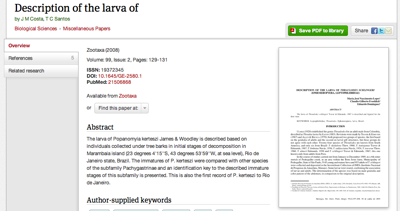
But it gets even more interesting. The abstract for the phantom Zootaxa article belongs to yet another paper:
Marques, K. I. D. S., & Xerez, R. D.Description of the larva of Popanomyia kerteszi James & Woodley (Diptera: Stratiomyidae) and identification key to immature stages of Pachygastrinae. Neotropical Entomology, 38(5), 643-648.which also exists in Mendeley.
To investigate further I used Mendeley's API to retrieve this record (I had to look at the source of the web page to find the internal identifier used by Mendeley, namely 010c48d0-edb5-11df-99a6-0024e8453de6 to do this, why does Mendeley hide these?). Here's the abbreviated JSON for this record.
{
  ...
  "website": "http:\/\/www.ncbi.nlm.nih.gov\/pubmed\/21506868",
  "identifiers": {
    "pmid": "21506868",
    "issn": "19372345",
    "doi": "10.1645\/GE-2580.1"
  },
  ...
  "issue": "2",
  "pages": "129-131",
  "public_file_hash": "fe7eed3f6c43a3be1480a0937229b9ad33666df4",
  "publication_outlet": "Zootaxa",
  "type": "Journal Article",
  "mendeley_url": "http:\/\/www.mendeley.com\/research\/description-larva\/",
  "uuid": "010c48d0-edb5-11df-99a6-0024e8453de6",
  "authors": [
    {
      "forename": "J M",
      "surname": "Costa"
    },
    {
      "forename": "T C",
      "surname": "Santos"
    }
  ],
  "title": "Description of the larva of",
  "volume": "99",
  "year": 2008,
  "categories": [
    39,
    203,
    37,
    52,
    43,
    40,
    210
  ],
  "oa_journal": false
}
Doesn't add much to the story, but does give us the sha1 for the PDF for the chimeric article (fe7eed3f6c43a3be1480a0937229b9ad33666df4). If I download the PDF for the article in Iheringia, Sér. Zool. it has the same sha1:
This article doesn't exist
openssl sha1 a11v93n2.pdf
SHA1(a11v93n2.pdf)= fe7eed3f6c43a3be1480a0937229b9ad33666df4
So, to summarise, this paper doesn't exist. It is credited to a journal that doesn't have DOIs, the DOI resolves to an article in a different journal, the abstract comes from another article in another journal, and the PDF is from a third article. OMG!
This is just weird
So, something about the way Mendeley merges references is broken. Merging references is a tough problem so there will always be cases where things go wrong. But it would be really, really helpful if Mendeley could display the set of articles that it has merged to create each canonical reference (say by listing the UUIDs for each article). Users could then see if badness had happened, and provide feedback, for example by highlighting references that are clearly the same, and those that are clearly different. Until this happens I'm a bit nervous about trusting Mendeley with my bibliographic data, I don't want it mangled into chimeric papers that don't exist.