Showing posts with label Scotland. Show all posts

Old Coin Collection Found - under a Road

.
One news item, just out, for the Coineys. They are so keen to point out that their hobby ('avocation') of collecting dugup ancient coins and artefacts has its roots in Renaissance and Enlightenment antiquarianism. They therefore want to want to establish a position of prestige with regard to archaeology which they see as a younger (daughter) discipline, but also to point out that dugup ancient coins on the market today "could have been" on the market for centuries and not recently looted items. This of course does not take into account three factors, the growth in numbers of collectors in the days when the population of the western world as a whole was much less than today, the growth in popularity of the hobby, and that artefacts have been dropping out of the 'pool' of those available on the market by mechanisms such as donation to public institutions and destruction or loss.

A recent find by archaeologists from West of Scotland Archaeology Service (WoSAS) draws attention to the later mechanism. Five ancient coins were found in archaeological supervision of landscaping works conducted in Port Glasgow, Scotland in redeposited topsoil mixed with hardcore from the adjacent road surface. They were found along a grassed verge during the removal of turf and seem to have been brought to the site with material that was imported onto the site during road construction. We are not told, but I wonder whether these coins were not found during a metal detector survey of this deposit?

A point of interest is a deposit adhering to one side of each of the coins which appears to be glue or resin. This suggests to the excavator that they may have been mounted at some time, which in turn could suggest that they may represent part of a former private antiquity collection. "Two of the coins appear to be very similar, and while one has a resin deposit on the obverse, on the other the resin is on the reverse, suggesting that the intention may have been to display them side-by-side, which would support the interpretation that they form part of a collection". Three of the coins are "ancient Greek" in type, but the other two are Late Roman in type. The coins have a suspicious look to them however, they are of types that should have been struck in silver (and the corrosion products in the photo do not really look like corroded base silver should look). One of the Macedonian ones has what seems to be a casting flash on the edge while the third "Greek" coin has very flat relief undifferentiated from the background and a soapy look typical of the cast fake. It seems that the collector who acquired these items on the antiquities market at some time (we are not told at what date the soil layer was dumped) did not have a very discerning eye.

The excavators suggest it was part of the scattered collection of an "antiquary", but I think the possibility that they formed part of some teaching material used in a local school cannot be ruled out.

Scotland’s buried heritage looted by treasure hunters

*
There is somewhat belated official concern that Scotland's archaeological heritage is being plundered by treasure hunters who fail to declare their finds in the national interest. In Scotland, any finds classed as treasure, including items such as axe heads and stone carvings as well as gold and jewels, must be declared to the Crown, which will pass them on to museums or other suitable collections for public display and study. Before any smartass but uninformed US coiney suggests it, Scotland awards finders full market value for finds added to the national collections like their English counterpart.

A report recently published by Crown officials admits what some archaeologists have been saying for ages, that there has been “serious under-reporting” of artefacts found by artefact hunters (Chris Watt, 'Scotland’s buried heritage looted by treasure hunters', Herald Scotland 17 Feb 2011):
Professor Ian Ralston, chairman of the Scottish Archaeological Finds Allocation Panel, said: “If you look at the amount of stuff found in Northumberland and Cumbria compared to the south of Scotland, there has to be a suspicion that there is a significant number of undeclared finds”. The problem is brought to light in the Scottish Treasure Trove annual report, published yesterday by the Queen’s and Lord Treasurer’s Remembrancer.
The report points out that the difference between the English and Scottish system is that objects found by artefact hunters and collectors north of a line on a map are liable to be added to public collections in the public interest, while south of the line collectors can add the stuff to their own private collections. All the arguments about "metal detectorists" contributing to the common good by recovering items are shown to be nonsense by this situation, what it is about is not "saving the 'eritidge" but about making a personal collection. As Watt points out "with treasures (sic) remaining in the hands of finders, the scheme south of the Border is seen by some critics as selfish". Indeed it is, no doubt about it - but its not the only area of antiquity collecting and trading that places selfish self-interest above all other considerations, such as decency, honesty and respect of the law.

But look at this:
There are around 100 members of Scotland’s two metal detecting clubs, according to Alastair Hacket, secretary of the Edinburgh-based Scottish Detector Club, with at least 100 more who pursue the hobby independently. Numbers have risen in recent years thanks to high profile successes like that of David Booth, the novice from Stirling who found £1 million-worth of gold in 2009 on his first outing with his new metal detector. The safari park worker received a £462,000 reward.
Just 200 in the whole country? Or is the number closer to 2000?

Vignette: Not-the-'British'-flag.

Scotland Lacks Numismatic Expertise?

*
I was interested in a comment at the end of the article by Chris Watt ('Scotland’s buried heritage looted by treasure hunters', Herald Scotland 17 Feb 2011) which indicates that numismatics is given low academic priority in Scotland:
Most discoveries in Scotland involve small artefacts like coins, but the Treasure Trove report warns that expertise in this area is now lacking due to the retirement of the country’s leading numismatist. The National Museums of Scotland has not replaced its coin expert, the report said, meaning that officials face the prospect of bringing a coin-dealer up from London to handle Scots finds.
Surely if there are no local numismatists capable of doing the job, it's probably easier to send batches down south. Does it have to be a dealer though? Why not knowledgeable collector (we are always being told by the coineys that there are such). Anyway in the majority of cases, can't this be done online these days? So the ACCG could help out too.

I suppose now we'll be hearing the coineys alleging that if the state gathers such finds for the public collections, this hinders the growth of coin collecting in Scotland, which deprives the nation of such expertise. I wonder though how many Scottish collectors are patrons of eBay and V-Coins regardless of what happens to local finds that are reported. And where do the finds that are not reported go? According to the coiney arguments, if the state takes them off finders reporting them, the rest must be melted down to create "tourist trinkets", eh?


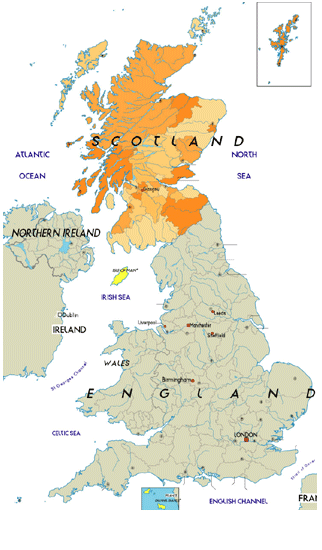
Vignette: map for US collectors of dugup ancient coins who have difficulty in distinguishing "England" from "Britain". Scotland is the orangy bit at the top.