Showing posts with label EOL. Show all posts

BHL needs to engage with publishers (and EOL needs to link to primary literature)

Browsing EOL I stumbled upon the recently described fish Protoanguilla palau, shown below in an image by rairaiken2011:
Palauan Primitive Cave Eel

Two things struck me, the first is that the EOL page for this fish gives absolutely no clue as to where you would to find out more about this fish (apart from an unclickable link to the Wikipedia page http://en.wikipedia.org/wiki/Protoanguilla - seriously, a link that isn't clickable?), despite the fact this fish has been recently described in an Open Access publication ("A 'living fossil eel (Anguilliformes: Protanguillidae, fam. nov.) from an undersea cave in Palau", http://dx.doi.org/10.1098/rspb.2011.1289).

Now that I've got my customary grumble about EOL out of the way, let's look at the article itself. On the first page of the PDF it states:
This article cites 29 articles, 7 of which can be accessed free
http://rspb.royalsocietypublishing.org/content/early/2011/09/16/rspb.2011.1289.full.html#ref-list-1

So 22 of the articles or books cited in this paper are, apparently, not freely available. However, looking at the list of literature cited it becomes obvious that rather more of these citations are available online than we might think. For example, there are articles that are in the Biodiversity Heritage Library (BHL), e.g.


Then there are articles that are available in other digitising projects

  • Hay O. P. 1903 On a collection of Upper Cretaceous fishes from Mount Lebanon, Syria, with descriptions of four new genera and nineteen new species. Bull. Am. Mus. Nat. Hist. N. Y. 19, 395–452. http://hdl.handle.net/2246/1500
  • Nelson G. J. 1966 Gill arches of fishes of the order Anguilliformes. Pac. Sci. 20, 391–408. http://hdl.handle.net/10125/7805

Furthermore, there are articles that aren't necessarily free, but which have been digitised and have DOIs that have been missed by the publisher, such as the Regan paper above, and


So, the Proceedings of the Royal Society has underestimated just how many citations the reader can view online. The problem, of course, is how does a publisher discover these additional citations? Some have been missed because of sloppy bibliographic data. The missing DOIs are probably because the Regan citation lacks a volume number, and the Trewavas paper uses a different volume number to that used by Wiley (who digitised Proc. Zool. Soc. Lond.). But the content in BHL and other digital archives will be missed because finding these is not part of a publisher's normal workflow. Typically citations are matched by using services ultimately provided by CrossRef, and the bulk of BHL content is not in CrossRef.

So it seems there's an opportunity here for someone to provide a service for publishers that adds value to their content in at least three ways:
  1. Add missing DOIs due to problematic citations for older literature
  2. Add links to BHL content
  3. Add links to content in additional digitisation projects, such as journal archives in DSpace respositories

For readers this would enhance their experience (more of the literature becomes accessible to them), and for BHL and the repositories it will drive more readers to those repositories (how many people reading the paper on Protoanguilla palau have even heard of BHL?). I've said most of this before, but I really think there's an opportunity here to provide services to the publishing industry, and we don't seem to be grasping it yet.

I think I now "get" the Encylopedia of Life

The Encylopedia of Life (EOL) has been relaunched, with a new look and much social media funkiness. I've been something of an EOL sceptic, but looking at the new site I think I can see what EOL is for. Ironically, it's not really about E. O. Wilson's original vision (doi:10.1016/S0169-5347(02)00040-X:
Imagine an electronic page for each species of organism on Earth, available everywhere by single access on command. The page contains the scientific name of the species, a pictorial or genomic presentation of the primary type specimen on which its name is based, and a summary of its diagnostic traits. The page opens out directly or by linking to other data bases, such as ARKive, Ecoport, GenBank and MORPHOBANK. It comprises a summary of everything known about the species’ genome, proteome, geographical distribution, phylogenetic position, habitat, ecological relationships and, not least, its practical importance for humanity.
We still lack a decent database that does this. EOL tries, but in my opinion still falls short, partly because it isn't nearly aggressive enough in harvesting and linking data (links to the primary literature anyone?), and has absolutely no notion of phylogenetics.

In terms of doing science I don't see much that I'd want to do with EOL, as opposed, say, to Wikipedia or existing taxonomic databases. But thinking about other applications, EOL has a lot of potential. One nice feature is the ability to make "collections". For example, Cyndy Parr has created a collection called Fascinating textures, which is simply a collection of images in EOL (I've included some below):

Textures
What is nice about this is that it cuts across any existing classification and assembles a set of taxa that share nothing other than having "fascinating textures". This ability to tag taxa means we could create all sorts of interest sets of taxa based on criteria that are meaningful in a particular context. For example, egotist that I am, I created a collection called Taxa described by Roderic Page, which includes the one crab and 6 bopyrid isopods that I described in the 80's.

Putting on my teaching hat, I'm involved in teaching a course on animal diversity and could imagine assembling collections of taxa relevant to a particular lecture (either taxonomically, or based on some other criteria, such as all parasites of a particular taxon, or all organisms found associated with deep sea vents. Other collections could be built by people or organisations with content. For example, lists of top ten new species, lists of species for which the BBC has content, etc.

In this sense, EOL becomes a tagging service for life, a bit like delicious. The social network side of things is still a little clunky —there doesn't seem to be a notion of "contacts" or "friends", and it needs integration with existing social networks — but I think I now "get" what EOL is for.

Navigating the Encyclopedia of Life tree on the desktop and the iPhone

This week seems to be API week. The Encyclopedia of Life API Beta Test has been out since August 12th. By comparison with the Mendeley API that I've spent rather too much time trying to get to grips with, the EOL API release seems rather understated.

However, I've spent the last couple of days playing with it in order to build a simple tree navigating widget, which you can view at http://iphylo.org/~rpage/eoltree/.

The widget resembles Aaron Thompson's Taxonomy (formerly called KPCOFGS) iPhone app in that it uses the iPhone table view to list all the taxa at a given level in a taxonomic tree. Clicking on a row in this table takes you to the descendants of the corresponding taxon, clicking "Back" takes you back up the tree. if you've reached a leave node (typically a species) the widget displays a snippet of information about that taxon. It also resembles Javier de la Torre's taxonomic browser written in Flex.

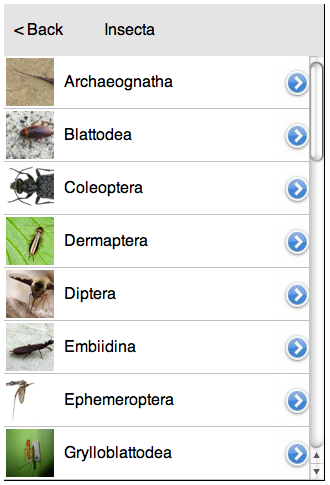
Here's a screen shot of the widget running in a desktop web browser:

insecta.png

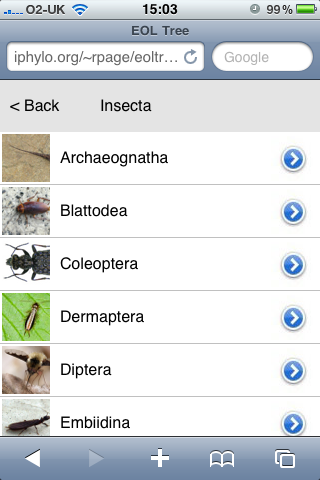
Here's the same widget in the iPhone web browser:

web.pngUsing the API
The EOL API is pretty straightforward. I call the http://www.eol.org/api/docs/hierarchy_entries API to get the tree rooted at a given node, then populate each child of that node using http://www.eol.org/api/docs/pages. The result is a simple JSON file that I cache locally to speed up performance and avoid hitting the EOL servers for the same information. because I'm locally caching the API calls I need a couple of PHP scripts to do this, but everything else is HTML and Javascript.

iPhone and iPad
I've not really developed this for the iPhone. I've cobbled together some crude Javascript to simulate some iPhone-like effects, but if I was serious about the phone I'd look into one of the Javascript kits available for iPhone development. However, I did want something that was similar in size to the iPhone screen. The reason is I'm looking at adding taxonomic browsing to the geographic browser I described in the post Browsing a digital library using a map, so I wanted something easy to use but which didn't take up too much space. In the same way that the Pygmybrowse tree viewer I played with in 2006 was a solution to viewing a tree on a small screen, I think developing for the iPhone forces you to strip things down to the bare essentials.

I'm also keeping the iPad in mind. In portrait mode some apps display lists in a popover like this:

popover_flatten.png

This popover takes up a similar amount of screen space to the entire iPhone screen, so if I was to have a web app (or native app) that had taxonomic navigation, I'd want it to be about the size of the iPhone.

Let me know what you think. Meantime I need to think about bolting this onto the map browser, and providing a combined taxonomic and geographic perspective on a set of documents,